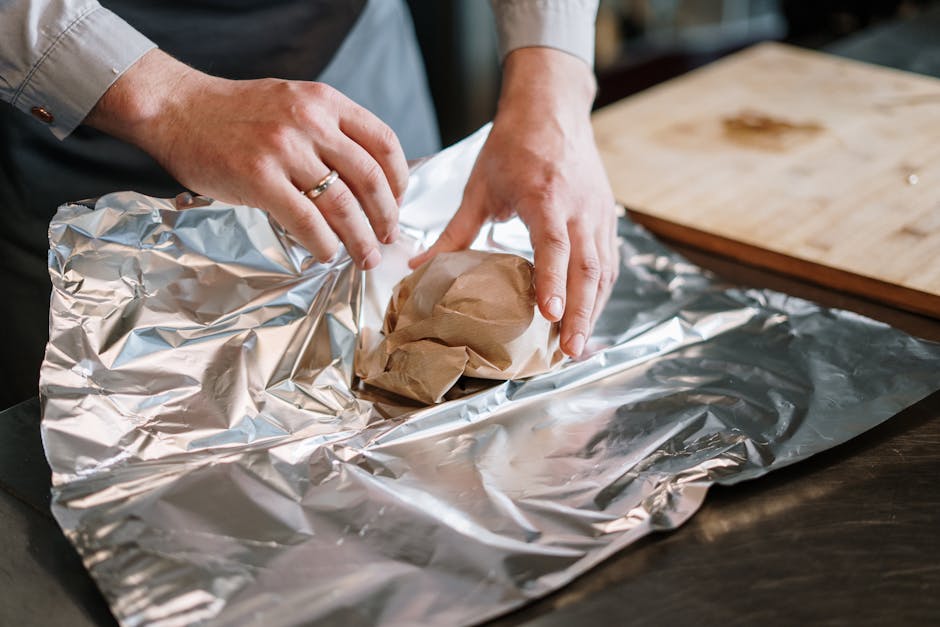
Photo: cottonbro studio / Pexels
Found this helpful? Share it!
Our team reviews cookware, appliances, and kitchen gadgets for home chefs so you don't have to. Every recommendation is based on real research: customer reviews, expert opinions, and value for money. Learn more about us →
Yes, you can put aluminum foil in an air fryer — as long as you use it correctly. Foil must be weighted down by food, kept away from the heating element, and never placed in a way that blocks airflow through the basket.
Aluminum foil is safe in most air fryers when it's placed in the basket (not the drawer beneath it) and covered with food to keep it from flying into the heating coil. Never line the bottom of the air fryer chamber itself, and never use foil during preheating when there's no food to hold it down. Avoid foil entirely with acidic foods like tomatoes, citrus, or vinegar-based marinades, which react with aluminum and can leach metallic flavor into your meal. If your air fryer's manual specifically prohibits foil, follow the manual — some models with bottom-mounted heating elements are genuinely unsafe.
Check that your air fryer has adequate clearance between the heating element and basket before using aluminum foil, as foil placed too close to the heat source can cause damage or fire hazards. Look for models with clear product manuals that specifically address foil usage and confirm your fryer's interior dimensions to ensure safe placement away from the coil.
An air fryer is essentially a compact convection oven. A fan forces superheated air around your food at high speed, and that circulation is the entire reason air fryers produce crispy results with little oil. Anything that interrupts that airflow — including a poorly placed sheet of aluminum foil — degrades performance and can create a genuine safety hazard.
The primary risk with foil isn't the material itself. Aluminum foil is oven-safe up to roughly 1,220°F, far beyond the 400–450°F ceiling of any consumer air fryer. The real danger is that loose foil is extremely lightweight, and the fan in an air fryer moves air aggressively enough to lift it. If a piece of foil gets sucked upward into the heating element, it can scorch, spark, or in worst-case scenarios ignite. This is why the single most important rule is: foil must always be weighted down by food.
The second issue is airflow obstruction. Air fryer baskets are perforated for a reason — hot air needs to reach the underside of your food. If you line the entire basket with foil, you've turned your air fryer into a slow, inefficient toaster oven. Food steams instead of crisps, cook times stretch, and the bottom of whatever you're cooking comes out pale and soggy. If you use foil, leave a generous margin around the edges and consider poking holes in it.
Third, never place foil in the outer drawer or on the bottom of the cooking chamber. In many air fryers, that space is where grease collects and where hot air needs to circulate back up. Blocking it traps heat around the heating element, which can cause the unit to overheat, trip its thermal cutoff, or in rare cases damage the appliance permanently. Some manufacturers — Philips and Ninja among them — explicitly warn against this in their manuals.
Finally, there's the chemistry problem. Aluminum reacts with acidic and highly salted foods. Cooking lemon-marinated chicken, tomato-based dishes, or vinegar-heavy preparations directly on foil causes small amounts of aluminum to migrate into the food. The quantities are generally considered safe by the FDA, but the metallic off-flavor is noticeable and unpleasant. For anything acidic, skip foil altogether.
Appliance manufacturers are cautiously permissive. Ninja's official guidance allows foil in the basket with food on top, while explicitly forbidding it in the crisper plate's lower cavity. Instant Brands says the same for its Vortex line. Philips, which invented the modern air fryer, recommends parchment over foil and advises against lining the drawer under any circumstances.
Food safety authorities are more concerned with the acidity issue than the fire risk. The FDA classifies aluminum as safe in food contact, but research published in food chemistry journals has consistently shown that acidic foods cooked in foil at high heat absorb measurably more aluminum than those cooked on inert surfaces. The World Health Organization's tolerable weekly intake gives most people plenty of headroom, but it's a reason many test kitchens have quietly moved away from foil for high-heat, high-acid cooking.
Professional test kitchens — including America's Test Kitchen and Serious Eats — generally recommend parchment over foil for air frying, citing better airflow through perforated liners, easier cleanup, no reactivity with acidic ingredients, and zero risk of a loose sheet reaching the heating coil. The consensus is straightforward: foil is allowed, but it's rarely the best tool.
If your goal with foil is easier cleanup — and for most people, it is — perforated parchment paper liners solve the problem better in every way. These pre-cut rounds and squares are made specifically for air fryer baskets, with holes punched throughout so hot air still reaches the bottom of your food. You get the crispy results the appliance is designed for, without scrubbing baked-on marinade out of a perforated basket.
Parchment liners don't react with acidic foods, so lemon-pepper wings, tomato-glazed meatballs, and vinegar-brined vegetables all cook cleanly. They're heavier than foil and sit flat in the basket, though the same rule applies: don't run them empty during preheat. A good set of air fryer parchment paper liners comes in multiple diameters to fit round baskets, square baskets, and dual-zone models, and a pack of 100–200 typically costs less than a single roll of heavy-duty foil. For anyone who uses their air fryer more than twice a week, it's the highest-value accessory you can buy.
Aluminum foil is safe in an air fryer when it's placed in the basket, weighted down with food, kept clear of the heating element, and never used with acidic ingredients. For everyday cooking, though, perforated parchment liners deliver the same easy cleanup with better airflow, zero reactivity, and less risk — making them the smarter default choice.
As an Amazon Associate I earn from qualifying purchases.
← Back to All Reviews| Retailer | Price Range | Shipping | Link |
|---|---|---|---|
| Amazon | Check Current Price | Free (Prime) | View on Amazon → |
| Walmart | Check Site | Free over $35 | Search → |
| Target | Check Site | Free over $35 | Search → |
Prices may vary. Click through to each retailer for current pricing.
Yes, you can safely use aluminum foil in an air fryer, but it works best when you secure it properly to prevent it from flying around. Make sure the foil doesn't block the air circulation vents, as this can affect cooking performance and safety.
Aluminum foil won't damage your air fryer if used correctly, but loose foil can touch the heating element and potentially burn or create a fire hazard. Always weigh down the foil with food or use it as a liner secured to the basket bottom.
Parchment paper is generally safer and easier to use than aluminum foil since it won't blow around and won't conduct heat as intensely. However, aluminum foil works fine if secured properly and is better for wrapping foods or creating barriers for delicate items.
Wrap delicate fish, cheese-topped items, or foods prone to drying out (like chicken breast) in foil to prevent over-browning and maintain moisture. You can also use foil to shield the edges of pastries or baked goods that brown too quickly.