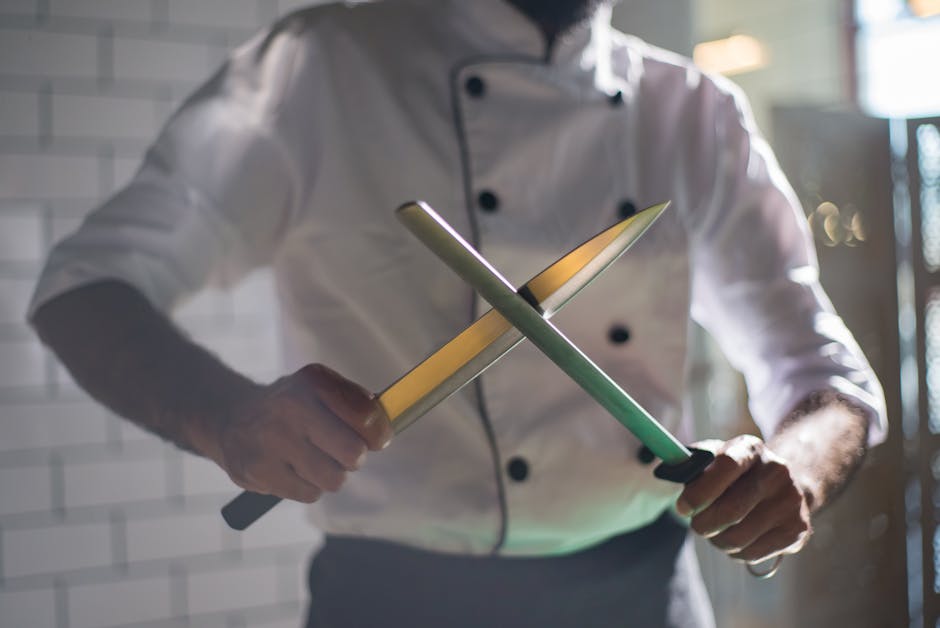
Photo: Kampus Production / Pexels
Found this helpful? Share it!
Our team reviews cookware, appliances, and kitchen gadgets for home chefs so you don't have to. Every recommendation is based on real research: customer reviews, expert opinions, and value for money. Learn more about us →
The best way to sharpen kitchen knives at home is with a two-stage manual pull-through sharpener: one coarse slot to grind a fresh edge and one fine slot to hone and polish it. For most home cooks, this method delivers a razor-sharp edge in under 60 seconds with almost no learning curve — unlike whetstones, which require 20+ minutes of practice and a steady hand to use correctly.
Use a two-stage manual knife sharpener. Pull the blade through the coarse slot 3–5 times with light, even pressure to reset the edge, then pull it through the fine slot 3–5 times to polish and align it. Sharpen every 2–3 months for regular use, and use a honing steel between sharpenings to keep the edge straight. If you own high-end Japanese knives or want maximum control, a 1000/6000-grit whetstone is the superior — but far more demanding — option.
Invest in a manual pull-through sharpener or whetstone rather than electric models, as they give better control and are less likely to damage your blade's edge with excessive material removal. For most home cooks, a simple two-stage pull-through sharpener offers the best balance of ease, consistency, and affordability compared to expensive electric alternatives or steep learning curves with whetstones.
First, understand the difference between sharpening and honing, because most people confuse them. Sharpening removes metal to create a new cutting edge. Honing simply straightens the microscopic edge that has rolled over during use. A honing steel does not sharpen a dull knife — it only restores a knife that is still fundamentally sharp. If your blade slides off a tomato skin instead of biting into it, honing won't save you. You need to sharpen.
There are four realistic options for sharpening at home:
Angle matters more than anything else. Western knives are typically ground at 20 degrees per side; Japanese knives at 15 degrees or less. Sharpening a 15-degree Japanese blade in a 20-degree sharpener will blunt the edge geometry over time. Check your manufacturer's spec before you start, and buy a sharpener that matches — or a dual-angle model that handles both.
Technique for a pull-through sharpener: Place it on a flat, non-slip surface and hold the base firmly. Set the heel of the blade in the coarse slot, then pull the knife straight toward you at a moderate, even speed, letting the tip come through last. Use the weight of the knife plus light downward pressure — pressing hard removes excess steel and shortens the blade's life. Three to five passes in the coarse slot, then three to five in the fine slot. Wipe the blade with a damp cloth to remove metal filings before you use it.
Test your edge with a sheet of printer paper. Hold it vertically and slice downward. A properly sharpened knife glides through cleanly without tearing or catching. If it snags, run a few more passes through the fine slot.
One important caution: pull-through sharpeners are not appropriate for serrated knives or single-bevel Japanese blades (yanagiba, usuba, deba). Serrated knives need a tapered ceramic rod worked into each individual scallop, and single-bevel knives need a whetstone. Never force either into a V-slot sharpener.
Professional chefs and knife makers broadly agree on two points. First, frequency beats intensity. A knife that gets a quick touch-up every few weeks stays sharp with minimal metal loss. A knife that gets ignored for two years requires aggressive grinding to recover, permanently shortening its lifespan. Sharpen before you think you need to.
Second, the best sharpener is the one you'll actually use. Culinary instructors consistently note that whetstones produce the finest edges, but they also acknowledge the reality: most home cooks buy a stone, use it twice, and let it collect dust in a drawer. A pull-through sharpener that lives on the counter and gets used monthly will keep your knives sharper year-round than a premium whetstone you never touch.
Cutlery manufacturers add a third point that gets ignored constantly: how you treat a knife between sharpenings matters as much as sharpening itself. Cutting on glass, granite, or ceramic plates destroys an edge in a handful of strokes. Use end-grain wood or soft plastic boards. Hand-wash and dry immediately — dishwasher detergent is abrasive and the heat can damage handles and temper. Store knives in a block, on a magnetic strip, or in blade guards, never loose in a drawer where they bang against other utensils.
Knife makers also warn against over-sharpening. Every pass removes steel. A quality chef's knife should last decades; grinding it down every week out of enthusiasm will visibly narrow the blade within a few years.
For 90% of home kitchens, a 2-stage manual knife sharpener is the right tool. It solves the single hardest part of sharpening — holding a consistent angle — by building the correct angle into the slots. You provide the pulling motion; the sharpener handles the geometry.
What to look for when choosing one:
Most solid options fall in the $15–$40 range — less than the cost of professional sharpening for a single set of knives, and it pays for itself the first time you use it. Pair it with a honing steel for weekly maintenance and your knives will stay in excellent shape indefinitely.
A two-stage manual sharpener is the fastest, most reliable way for a home cook to keep knives genuinely sharp, and it takes less than a minute per blade. Sharpen regularly rather than waiting until a knife is hopeless, and a good set of kitchen knives will outlast most of the appliances in your kitchen.
As an Amazon Associate I earn from qualifying purchases.
← Back to All Reviews| Retailer | Price Range | Shipping | Link |
|---|---|---|---|
| Amazon | Check Current Price | Free (Prime) | View on Amazon → |
| Walmart | Check Site | Free over $35 | Search → |
| Target | Check Site | Free over $35 | Search → |
Prices may vary. Click through to each retailer for current pricing.
A honing steel is the easiest option for quick maintenance between sharpenings, but for actually restoring a dull blade, a pull-through sharpener or whetstone works best. Pull-through sharpeners are the most beginner-friendly since they guide the blade at the correct angle automatically, while whetstones offer more control once you learn the technique.
No, you don't need a whetstone—pull-through sharpeners, electric sharpeners, and manual sharpening systems all work effectively. However, whetstones are considered the gold standard by professionals because they give you the most control and preserve more of your blade over time.
Most home cooks should sharpen their knives every 3-6 months with regular use, though this depends on how often you cook and what you cut. Before that, use a honing steel weekly to realign the blade's edge and extend the time between sharpenings.
You can absolutely sharpen kitchen knives at home with the right tool—it's not difficult or expensive to get started. A basic pull-through sharpener costs $10-20 and works great for home cooks, or invest $30-50 in a whetstone if you want more precision and longevity for your knives.