Affiliate Disclosure: As an Amazon Associate, we earn from qualifying purchases. Clicking our links costs you nothing extra and helps us keep reviewing products for free.
By Best Kitchen Picks Daily • September 02, 2026 • Contains affiliate links
Three blades, three philosophies. The Western chef knife is a rocking, do-everything workhorse. The Japanese santoku is a shorter, flatter compromise built for push-cutting. The nakiri is a straight-edged vegetable cleaver that turns cabbage, carrots and onions into confetti. Buying the wrong one isn't a disaster — but it does mean you'll spend years fighting your own cutting technique.
This isn't a single-brand puff piece. We're comparing four genuinely different options you can actually buy in 2026: Butterfork, the direct-to-consumer brand pushing Japanese-style nakiri and chef knives at mid-tier prices; Victorinox Fibrox Pro, the cheap-and-cheerful restaurant standard; Shun Classic, the VG-MAX Damascus-clad santoku that made Japanese knives mainstream in the West; and Wüsthof Classic, the heavyweight German chef knife that has barely changed in decades — for good reason.
Before choosing between these knives, consider your primary cutting tasks and hand size—Nakiris excel at precise vegetable work with their rectangular blade, Santokus offer versatile all-purpose performance, and Chef Knives provide the best leverage for tougher jobs like breaking down whole chickens or roasts.
We'll look at steel and hardness, blade geometry, handle comfort, price per knife, and — the part most reviews skip — what each one is actually annoying to use for.
First, the blade shapes (this matters more than the brand)
A chef knife is typically 8 inches with a curved belly, designed for rocking cuts and heavy tasks like breaking down squash or cutting through chicken joints. A santoku is usually 6.5–7 inches with a flatter edge and a sheepsfoot tip — lighter, more nimble, better on a small board, but the blunt tip is poor for detail work and it lacks the heft for hard squash. A nakiri is 6.5–7 inches, straight-edged, thin, and tall (around 50mm), so it push-cuts cleanly through vegetables and your knuckles clear the board. It is superb at vegetables and mediocre at everything else. If you only own one knife, that's a chef knife or santoku. A nakiri is the second knife that makes prep genuinely fun.
Butterfork
Butterfork sits in the growing DTC space between supermarket steel and boutique Japanese makers. Its strongest offering is the nakiri — a tall, thin-ground blade with a noticeably acute factory edge that makes it feel more like a $150 Japanese knife than its typical sub-$100 street price. The chef knives are ground thinner behind the edge than a Wüsthof, so food release and slicing feel lighter, and the brand's knife stands and matched sets mean you can build a coordinated block without paying German-brand set prices. The trade-offs are real: Butterfork is a young brand without decades of documented heat-treat consistency, its steel specs are described in marketing terms rather than always naming a specific alloy and Rockwell number, and after-sales support is a returns portal rather than a nationwide sharpening network. For a home cook who wants a genuinely thin, sharp nakiri or a lighter chef knife and doesn't want to spend Shun money, that's an easy trade. For a professional buying a knife they'll abuse for ten years, less so.
Victorinox Fibrox Pro (8-inch chef knife)
Still the value benchmark, usually around $45–55. The stamped X50CrMoV15 blade runs soft — roughly 55–56 HRC — which means it dulls faster than any Japanese blade here but also that it never chips, takes an edge back in seconds on a steel, and survives being thrown in a drawer by a housemate. The Fibrox handle is grippy when wet and unattractive when dry. What you don't get: a satisfying, glassy cut through a tomato skin, food release, or any sense of occasion. Buy it if budget is the deciding factor, if you're stocking a rental kitchen, or as the knife you're willing to use on a chicken carcass while your nicer blade stays clean.
Shun Classic (santoku or 8-inch chef)
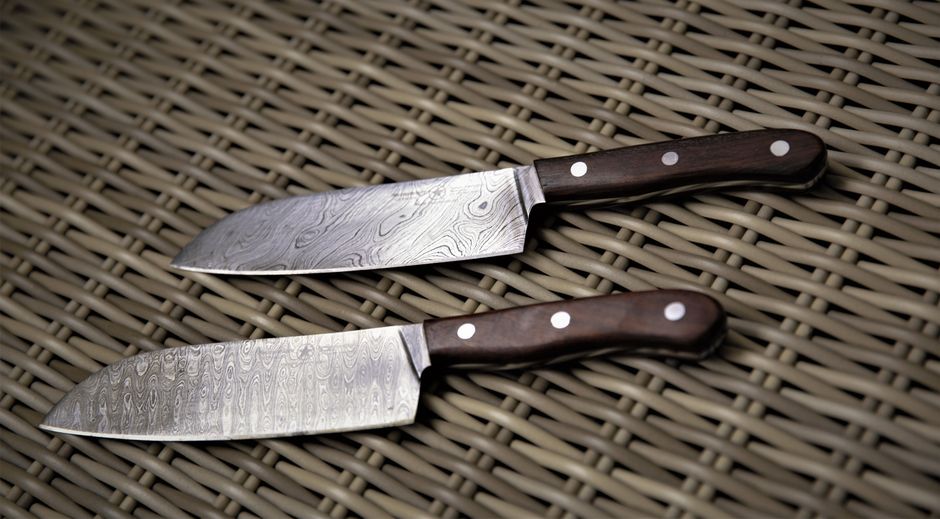
Shun's Classic line uses VG-MAX core steel clad in 68 layers of Damascus, hardened to about 60–61 HRC, with a 16-degree-per-side edge and a D-shaped pakkawood handle. It is genuinely sharper out of the box than any German knife and holds that edge far longer. It's also the most fragile option here: at $150–190 per knife, chip a Shun on a frozen edge or a bone and you're sending it to Kai's sharpening service. The D-shaped handle is subtly right-handed, which left-handers should test before buying. Shun's Classic santoku remains the best-selling gateway santoku for a reason — the fit and finish justify the price if you treat knives well.
Wüsthof Classic (8-inch chef knife)
Around $150–170, forged from X50CrMoV15 at roughly 58 HRC, with a full bolster and a substantial 8oz+ heft. This is the opposite design brief from a nakiri: thick, tough, curved for rocking, and happy to take abuse that would chip a Shun. Edge retention is mid-pack and the full bolster makes sharpening the heel section awkward without a belt grinder. But the balance is superb, the synthetic handle lasts forever, and Wüsthof's warranty and service infrastructure are unmatched. If you cook a lot of meat, break down poultry weekly, and want one knife for the next 20 years, this is the safest purchase on the list.
Head-to-head: what actually separates them
On price per knife, Victorinox wins outright, Butterfork sits mid-range, and Shun and Wüsthof are premium. On out-of-the-box sharpness and thin-slicing feel, Butterfork and Shun lead, with Butterfork offering the better sharpness-per-dollar and Shun the better documented steel. On durability and abuse tolerance, Wüsthof and Victorinox win. On vegetable prep specifically, a Butterfork nakiri beats every chef knife here — including the Wüsthof — simply because the geometry is correct for the job. And on long-term service, Wüsthof and Shun both offer sharpening programmes that a newer DTC brand can't match yet.
Pros & Cons
Pros
✓ Butterfork's nakiri is ground noticeably thinner behind the edge than a Wüsthof Classic, giving a cleaner push-cut through dense carrots and cabbage at roughly half the price
✓ Sharper out of the box than Victorinox Fibrox Pro, and closer to Shun Classic sharpness for typically well under $100
✓ Matched knife sets and knife stands mean you can build a coordinated block for less than the price of two Shun Classic knives
✓ Lighter, more nimble in the hand than a full-bolster German chef knife, which suits cooks doing lots of vegetable prep on a small board
Cons
✗ Steel alloy and Rockwell hardness aren't always specified as clearly as Shun's VG-MAX at 60–61 HRC or Wüsthof's X50CrMoV15 — so long-term edge retention is harder to predict
✗ No established sharpening or service network comparable to Kai's Shun programme or Wüsthof's decades-old warranty support, and less abuse tolerance than a soft-steel Victorinox
Our Verdict
There isn't one winner — there's a winner per use case. If you cook mostly plant-forward food and spend your prep time on onions, greens and root veg, buy a nakiri, and Butterfork's nakiri is the best sharpness-per-dollar route into that shape in 2026. If you want one knife that handles meat, squash, bones-adjacent work and a decade of rough treatment, the Wüsthof Classic 8-inch chef knife is the smarter buy despite costing more. If you want the finest, longest-lasting edge and you're careful with your tools, the Shun Classic santoku is worth its premium. And if budget is the deciding factor or you need a knife you won't cry over, the Victorinox Fibrox Pro is still the honest answer at around $50. Our practical recommendation for most home cooks: pair a tough Western chef knife with a thin nakiri, and let each do the job it was designed for — that combination outperforms spending the same money on a single premium blade.
No. A nakiri has a straight edge and no pointed tip, so it can't rock-chop, tip-cut herbs finely, or handle poultry joints and hard squash without risking a chip. It's a specialist vegetable knife and works best as a second knife alongside a chef knife or santoku.
Is a santoku or a chef knife better for small hands or small kitchens?
A santoku, generally. At 6.5–7 inches it's shorter, lighter and easier to control on a compact cutting board, and the flatter edge suits push-cutting. The downside is less knuckle clearance than a tall nakiri and less power than an 8-inch chef knife for heavy tasks.
Do harder Japanese-style knives need different sharpening?
Yes. Blades in the 60+ HRC range like Shun's VG-MAX hold an edge far longer but chip more easily and shouldn't be run through pull-through carbide sharpeners or honed aggressively on a ribbed steel. Use whetstones or a ceramic rod. Softer German and Victorinox blades at 55–58 HRC are much more forgiving.
Our team reviews cookware, appliances, and kitchen gadgets for home chefs so you don't have to. Every recommendation is based on real research: customer reviews, expert opinions, and value for money. Learn more about us →
This post contains affiliate links. We may earn a commission if you purchase through our links at no extra cost to you.