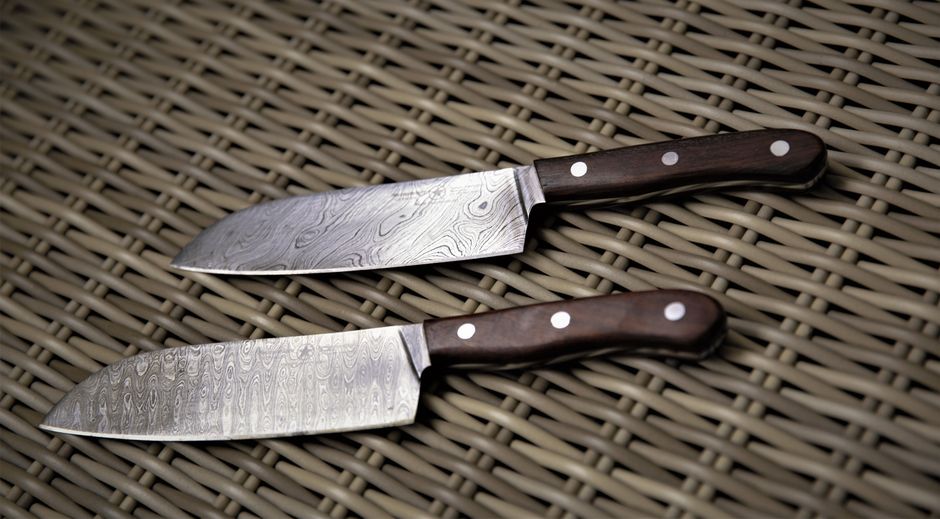
Photo: Sternsteiger Stahlwaren / Pexels
If you're building a kitchen knife collection, you've likely encountered three popular options: the chef's knife, the utility knife, and the santoku. While all three are essential to many home cooks, they excel at different tasks and suit different cutting styles. The confusion comes from genuine overlap—all three can chop vegetables, but they do it very differently.
When choosing between a chef's knife, utility knife, and santoku, consider your primary cutting tasks and hand size first—a chef's knife excels at rocking motions for herbs and vegetables, a utility knife handles smaller precision work, and a santoku works best for clean slicing if you prefer a straighter up-and-down chopping motion, so test holding each style before committing to avoid buying a knife that feels awkward in your grip.
This guide compares these three knives head-to-head across blade design, size, cutting technique, and real-world use cases, so you can make an informed decision about which ones belong in your kitchen.
The chef's knife is a large Western-style blade, typically 7–10 inches long with 8 inches being the standard home kitchen size. Its defining feature is a curved edge engineered for the rocking motion—where the blade tip stays anchored on the cutting board while you move the handle up and down. The blade's height and width provide leverage for cutting through tougher ingredients and handling volume work.
Best for: Home cooks who need one multipurpose knife for everyday prep; bulk vegetable chopping, slicing meat, and mincing herbs.
The utility knife occupies the middle ground between a chef's knife and a paring knife, with blades ranging from 5–7 inches. It's smaller and more maneuverable than a chef's knife but larger than a paring blade, making it ideal for detailed work that requires more control than a chef's knife provides. Utility knives work well for both larger and finer tasks, though they lack the leverage and cutting surface of a full chef's knife.
Best for: Cooks who want a second blade for precision tasks like trimming fat, slicing smaller ingredients, or detailed vegetable work; ideal as part of a multi-knife setup.
The santoku is a Japanese knife, typically 5–7 inches long, with a flatter, straighter blade and only a slight curve near the tip. Rather than the rocking motion of a Western chef's knife, the santoku is optimized for vertical, up-and-down chopping motions. This design delivers precise cuts on vegetables, fish, and meat using a different technique altogether, making it a tool for finesse rather than leverage.
Best for: Cooks who prefer precise, controlled cutting motions; Japanese cuisine enthusiasts; those who value fine detail work over bulk prep; users comfortable with a learning curve on cutting technique.
Start with a chef's knife. If you're buying one knife, the 8-inch chef's knife is the best all-around choice. It handles bulk prep, is forgiving for beginners, and works for nearly every cutting task in Western cooking. The curved blade and rocking motion are intuitive for most home cooks.
Add a utility knife next. Once you're comfortable with your chef's knife, a 5–7 inch utility knife becomes genuinely useful. It makes detailed work faster and safer—trimming, slicing smaller items, and precision cuts are easier with a smaller, more maneuverable blade. A utility knife is a logical second purchase that doesn't overlap much with a chef's knife.
Consider a santoku only if you're interested in Japanese cooking or prefer precision over speed. The santoku is not a replacement for a chef's knife; it's a different tool for a different technique. If you already have a chef's knife and utility knife, a santoku won't dramatically change what you can do—it changes how you do it. It's best for cooks who cook regularly, have developed knife skills, or are specifically drawn to Japanese culinary techniques.
The practical recommendation: Most home kitchens thrive with a chef's knife + utility knife combo. The santoku is a specialty addition for those who want it, not a necessity.
Not entirely. While a santoku can chop vegetables very well, it's not as versatile for meat work, mincing, or tasks requiring the leverage a chef's knife provides. They're complementary tools, not interchangeable ones.
You don't absolutely need one, but a utility knife makes detailed work significantly easier and safer. If you regularly trim fat from meat, slice smaller items, or do delicate vegetable work, a utility knife will become a regular reach for you.
Chef's knives use a rocking motion (tip stays on the board, handle moves up and down); utility knives use the same rocking motion but with more control; santoku knives use vertical, up-and-down chopping motions without the rocking action.
The chef's knife. Its curved blade and rocking motion are more forgiving for beginners. The santoku requires learning a new technique and is better suited to cooks who already have knife skills.
Yes, if you're comfortable with its technique and prefer its precision. However, you'll find it less efficient for bulk prep work. Most home cooks use a chef's knife for everyday cooking and add a santoku only if they develop a preference for it.
Found this helpful? Share it!
Our team reviews cookware, appliances, and kitchen gadgets for home chefs so you don't have to. Every recommendation is based on real research: customer reviews, expert opinions, and value for money. Learn more about us →
This post contains affiliate links. We may earn a commission if you purchase through our links at no extra cost to you.
← Back to Best Kitchen Picks Daily| Retailer | Price Range | Shipping | Link |
|---|---|---|---|
| Amazon | Check Current Price | Free (Prime) | View on Amazon → |
| Walmart | Check Site | Free over $35 | Search → |
| Target | Check Site | Free over $35 | Search → |
Prices may vary. Click through to each retailer for current pricing.