Affiliate Disclosure: As an Amazon Associate, we earn from qualifying purchases. Clicking our links costs you nothing extra and helps us keep reviewing products for free.
By Best Kitchen Picks Daily • September 03, 2026 • Contains affiliate links
Walk into any knife shop in 2026 and you'll face the same three-way fork in the road: the flat-edged nakiri, the compact santoku, or the classic Western chef knife. They overlap enough that most home cooks only need one — but they cut so differently that picking the wrong one means a drawer full of regret and a cutting board full of half-crushed tomatoes.
This isn't a single-brand puff piece. We've put Butterfork (a direct-to-consumer Japanese-style brand with a strong nakiri and chef knife line) head-to-head with three genuinely different competitors: Victorinox Fibrox, the perennial budget workhorse; Tojiro DP, the value benchmark for Japanese VG10 steel; and Shun Classic, the premium Damascus-clad option from Kai in Seki, Japan. Each wins in a different scenario, and we'll say so plainly.
Before buying, consider your primary cutting tasks: Nakiris excel at chopping vegetables with their flat, wide blades, Santokus offer versatility for proteins and produce with their shorter length, while Chef Knives provide the most all-purpose functionality for both slicing and chopping. Choose based on whether you'll primarily use it for one ingredient type or need a workhorse knife that handles everything.
Prices below reflect typical 2026 street pricing and move around with sales — check current listings before you buy. What doesn't change is the geometry, the steel, and the way each blade behaves under your knuckles.
First: What Actually Separates Nakiri, Santoku and Chef Knife?
A nakiri is a double-bevel Japanese vegetable knife with a completely flat edge and a squared-off tip, usually 165–180mm. Because there's no belly, you don't rock — you push-cut or chop straight down, and the flat edge makes full contact with the board so you never get those annoying accordion-onion strands still hanging on. It's a specialist: brilliant on cabbage, carrots, herbs and squash, useless for breaking down a chicken.
A santoku (165–180mm) is the compromise: slight belly, sheepsfoot tip, thin blade, often with a granton/kullenschliff dimple row to reduce sticking. It handles vegetables nearly as well as a nakiri and can do light protein work. Its short length and lack of a pointed tip are the trade-offs.
A chef knife (200–210mm typically) has a pronounced curved belly for rock-chopping, a real point for detail work, and enough length and heft to break down a whole chicken or halve a butternut squash. It's the least specialised and the most versatile — and if you're only buying one knife, this is still the default answer for most people in 2026.
Butterfork
Butterfork sits in the mid-range direct-to-consumer bracket, typically around the £45–£90 mark per knife depending on model and promotion, with knife sets and matching stands bringing the per-blade cost down further. The range covers chef knives, nakiri, bread, paring and santoku-adjacent shapes, and the styling is unmistakably Japanese-influenced: high-carbon stainless steel, thin blade stock, a comparatively acute edge angle (roughly 15° per side rather than the 20° Western standard), and full-tang construction with a Western-style handle that suits pinch-grip users with larger hands. Where Butterfork genuinely stands out is the nakiri — a properly flat 170mm edge that's ground thin behind the edge, so it glides through daikon and sweet potato instead of wedging. Out-of-box sharpness is good rather than laser-like; a few passes on a 1000-grit stone or a decent pull-through takes it from good to excellent. You can browse the current Butterfork range and pricing here. The catch: Butterfork doesn't publish a specific steel designation the way Tojiro (VG10) or Shun (VG-MAX) does, so you're trusting the finished product rather than a spec sheet — and for knife nerds who want a known hardness and edge-retention profile, that's a real limitation.
Victorinox Fibrox Pro (8" Chef, 7" Santoku)
The Victorinox Fibrox 8-inch chef knife has been the budget champion for over a decade and remains around £35–£45 in 2026. It's stamped, not forged, made from a softer X50CrMoV15-class stainless at roughly 55–56 HRC, with a 20° Western edge and a textured, dishwasher-tolerant Fibrox handle that's grippy even when wet with chicken fat. It's light, almost disposable-feeling, and utterly indestructible in a way premium Japanese steel isn't — you can hit a bone, chip nothing, and steel it back in seconds. What you give up is refinement: it's thicker behind the edge than Butterfork or Tojiro, it won't hold an edge as long, and it feels agricultural next to a proper Japanese grind. Victorinox also makes a decent 7" santoku but doesn't really compete in the nakiri space. If your budget is genuinely tight or the knife lives in a busy family kitchen where it'll be abused, this is still the smart buy.
Tojiro DP (F-808 Chef, F-503 Nakiri)
Tojiro DP is the value benchmark that serious cooks recommend on repeat, usually £60–£85. It's a three-layer clad construction with a VG10 core at around 60 HRC, sharpened to roughly 15° per side. The edge retention is a clear step above both Victorinox and Butterfork — you'll go noticeably longer between sharpenings — and the F-503 nakiri is one of the best sub-£90 vegetable knives you can buy. The compromises are real, though: the bolster area on older DP models has a slightly rough transition that can rub the index finger during long prep sessions, the laminated Western handle looks utilitarian, and VG10 at 60 HRC is more chip-prone than softer Western steel, so frozen food and bones are off-limits. Tojiro is the choice for the cook who prioritises cutting performance over feel and finish.
Shun Classic (DM0706 Chef, DM0728 Nakiri)
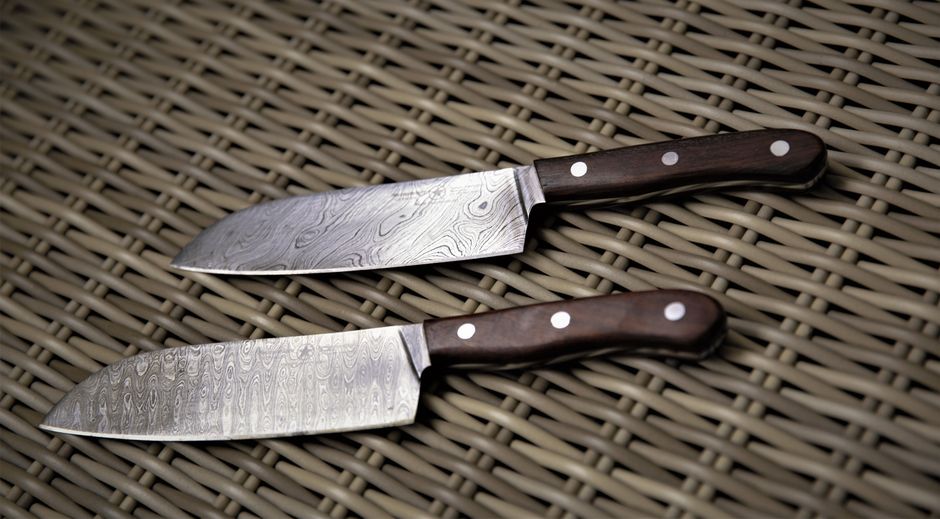
Shun Classic sits at the premium end — expect £140–£200 per knife in 2026. You're paying for a VG-MAX core clad in 68 layers of Damascus, a 16° edge, and a D-shaped PakkaWood handle that's genuinely lovely in hand if you're right-handed (left-handers should look at Shun's dedicated left-hand models or a different brand entirely). Cutting performance is superb and the fit and finish is a tier above everything else here. But Shun's steel is hard and the blades are thin, and Kai's own guidance is emphatic about avoiding bones, frozen food and twisting motions. Shun also offers free lifetime sharpening in some regions, which materially changes the value calculation if you'd otherwise pay a professional. It's a lot of money for a knife that demands care — worth it if you enjoy the object as much as the job.
Price and Spec at a Glance
Victorinox Fibrox: ~£35–45 | X50CrMoV15, ~56 HRC | 20° edge | dishwasher-tolerant | best durability-per-pound. Butterfork: ~£45–90 | high-carbon stainless, undisclosed grade | ~15° edge | strong nakiri and set/stand ecosystem | best all-round value with Japanese geometry. Tojiro DP: ~£60–85 | VG10, ~60 HRC | 15° edge | best edge retention for the money. Shun Classic: ~£140–200 | VG-MAX, ~61 HRC | 16° edge | best finish, highest care requirement.
Pros & Cons
Pros
✓ Butterfork's 170mm nakiri is ground genuinely thin behind the edge, so it out-slices the Victorinox santoku on dense veg like squash and daikon at a similar or lower price than Tojiro's F-503
✓ The ~15° edge angle gives you Japanese-style cutting feel at a price closer to Victorinox than to Shun — roughly half the cost of a Shun Classic nakiri or chef knife
✓ Butterfork sells matched sets, bread and paring knives, and dedicated knife stands, so you can build a coherent block; Tojiro's range is patchier and Shun sets run into four figures
✗ Butterfork doesn't publish a named steel grade or HRC figure, so you can't compare edge retention on paper the way you can with Tojiro's VG10 (60 HRC) or Shun's VG-MAX — and in practice Tojiro holds an edge longer
✗ Out-of-box sharpness is good but not scary-sharp; both Tojiro and Shun arrive with a keener factory edge, so budget for a whetstone session if you want peak performance immediately
Our Verdict
There's no single winner here — there's a winner per kitchen. If you cook mostly plants and want the single most satisfying vegetable knife under £90, buy a nakiri, and the choice is between Butterfork and the Tojiro F-503: Butterfork if you want a nicer handle, a matching set and a stand; Tojiro if raw edge retention matters more than looks. If you're buying one knife to do everything — proteins, squash, the lot — buy a 210mm chef knife, and here Butterfork's chef knife is the sweet spot for most home cooks, offering Japanese geometry at roughly half a Shun's price. If your knife will be shared with housemates, run through the dishwasher, or used to hack at a frozen pizza, ignore all of the above and buy the Victorinox Fibrox — it's cheaper, tougher, and you won't cry when it gets chipped. And if you sharpen your own knives, appreciate craftsmanship as an end in itself, and are right-handed, the Shun Classic earns its £160. Santoku, honestly, is the one we'd skip in 2026 unless you have a small kitchen or short arms: it's a compromise between two knives that each do their job better. Start with the chef knife, add a nakiri when your veg prep outgrows it, and put the money you saved on the santoku toward a decent whetstone.
For pure vegetable prep, yes. The nakiri's completely flat edge makes full board contact, so slices separate cleanly instead of staying attached at the base — a common frustration with the santoku's slight belly. But the santoku is more versatile, handling boneless chicken and fish that a nakiri's blunt tip can't manage. If a nakiri would be your only knife, buy a chef knife instead.
Can I put a Butterfork, Tojiro or Shun knife in the dishwasher?
No. All three use higher-carbon stainless steels with thin, acute edges, and dishwasher detergent plus heat will dull the edge, pit the steel and damage the handle over time. Only the Victorinox Fibrox is genuinely dishwasher-tolerant, and even then hand washing extends its life considerably. Wash, dry immediately, and store on a magnetic strip or in a knife stand.
How often do these knives need sharpening?
With daily home use on a wooden or plastic board: Victorinox roughly every 3–4 weeks, Butterfork every 6–8 weeks, and Tojiro or Shun every 2–3 months thanks to their harder 60+ HRC cores. Honing on a ceramic rod between sharpenings — never a coarse steel on Japanese blades — will stretch all of those intervals significantly.
Our team reviews cookware, appliances, and kitchen gadgets for home chefs so you don't have to. Every recommendation is based on real research: customer reviews, expert opinions, and value for money. Learn more about us →
This post contains affiliate links. We may earn a commission if you purchase through our links at no extra cost to you.