Photo: Sternsteiger Stahlwaren / Pexels
Home cooks face a genuine choice when selecting their first quality chef's knife: German or Japanese style? These aren't just regional preferences—they represent fundamentally different engineering philosophies that affect how you'll actually cook day-to-day.
German chef knives are heavier, feature wider blades with bolsters for finger protection, and use a gentler 15-20 degree edge angle that prioritizes durability. Japanese knives are lighter, sharper (10-15 degree angles), and require more careful maintenance but reward you with precision cuts. Neither is universally "better"—the right choice depends on your hand size, storage space, cooking style, and willingness to maintain your tools.
When choosing between German and Japanese chef knives, test the weight and balance in hand if possible, since German knives tend to be heavier with a curved blade for rocking motions, while Japanese knives are lighter with flatter blades designed for up-and-down chopping. Consider your cutting style and counter space—German knives need more room to work but require less frequent sharpening, whereas Japanese knives demand regular honing but excel at precise, thin slicing in compact kitchens.
This guide compares the real differences so you can choose the knife that actually fits your kitchen, not just marketing hype.
German chef knives typically weigh 6-8 ounces and feature substantial metal concentrated toward the heel, allowing gravity to assist your cuts. The 15-20 degree edge angle is more durable than Japanese alternatives and forgives occasional honing neglect. High-carbon stainless steel resists rust better than pure carbon steel, making these knives practical for home cooks who won't baby their equipment.
The bolster (thick band where handle meets blade) provides both finger protection during chopping and a natural resting point for your knuckles—a significant safety advantage for extended prep work.
Best for: Home cooks who want a workhorse knife requiring minimal maintenance, those with medium-to-large hands, and kitchens with limited storage space
Japanese chef knives are lighter (typically 5-6 ounces) with more acute edge angles (10-15 degrees) that deliver sharper, more precise cuts. They're excellent for fine vegetable work and tasks requiring finesse rather than brute force. Modern Japanese stainless blends provide corrosion resistance similar to German knives while maintaining that signature sharpness.
The trade-off: the thinner edge is more prone to damage if used on bones or frozen items, and they require more attentive honing to maintain their edge quality between sharpenings.
Best for: Home cooks who prioritize cutting precision, those with smaller hands, and cooks willing to develop regular maintenance habits
These entry-level German stainless options provide the core German design benefits—weight, bolster protection, durable edge angle—at a fraction of premium prices. They won't hold an edge quite as long as high-carbon versions, but they're forgiving for beginners learning proper knife technique and won't catastrophically fail during normal home cooking.
The limitation is edge retention; you'll sharpen more frequently than with premium German or Japanese options, but the low initial cost makes this acceptable for many home cooks.
Best for: Beginners testing whether they'll actually use a quality knife, budget-conscious cooks preparing weeknight meals, and those wanting a practice tool before investing in premium options
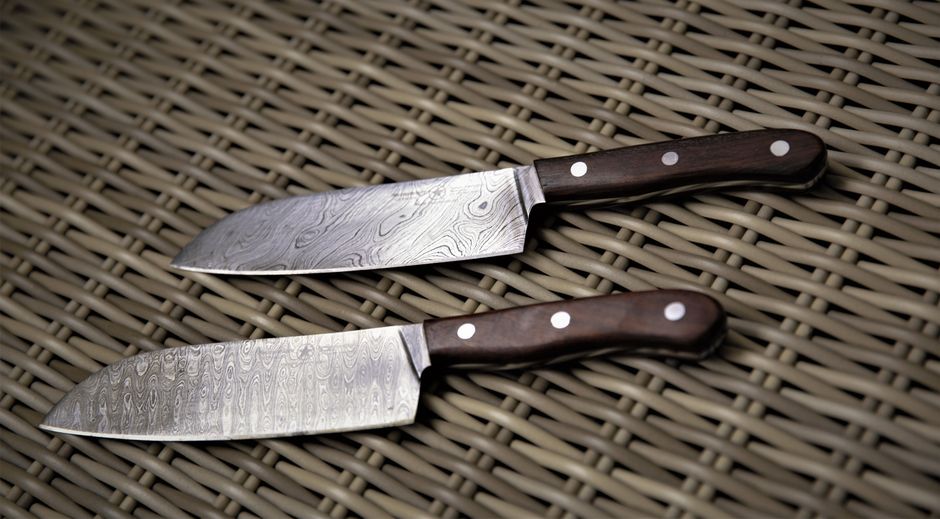
Premium Japanese knives feature decorative Damascus patterns (purely aesthetic), harder stainless blends, and superior edge geometry. These are precision instruments: they stay sharp longer than German equivalents and require less frequent maintenance than pure carbon steel.
The cost reflects both material quality and manufacturing precision. These knives reward careful use and regular maintenance with genuinely exceptional performance—particularly noticeable during detailed vegetable work or fine slicing tasks.
Best for: Serious home cooks committed to knife maintenance, those who prepare multiple meals daily, and cooks who genuinely notice the difference between a 15-minute and 25-minute vegetable prep session
Full sets include an 8-inch chef's knife, 3-4 inch paring knife, and often a serrated utility knife. This appeals to home cooks wanting a complete solution, but most households only genuinely use the chef's knife regularly. Sets force you to buy knives you may not need, often at a slightly better per-piece price than buying individually.
If a set actually includes the exact 8-inch chef's knife you wanted (rather than forcing a compromise), it's reasonable value. Otherwise, buying one excellent 8-inch knife beats owning three mediocre ones.
Best for: Home cooks setting up a new kitchen from scratch, those wanting simplicity in a single purchase, and cooks confident they'll use multiple blade types
For most home cooks: a German high-carbon stainless 8-inch chef's knife is the practical choice. The bolster provides safety you'll actually appreciate, the edge angle forgives maintenance gaps, and you can genuinely ignore it for weeks without performance degradation. Brands in the $40-70 range (like the German stainless options mentioned) deliver 85% of premium performance at half the price, with only slightly shorter edge retention between sharpenings.
Choose Japanese only if you cook multiple meals daily and genuinely notice the difference between sharp and merely adequate. The precision is real, but it requires commitment: regular honing, careful technique, and avoiding bones. For weekend home cooks, this investment rarely pays off.
Budget stainless (under $50) makes sense only as a first knife—buy one to test whether you'll actually use a quality blade before graduating to premium options. The edge retention is mediocre, but the low cost means you're not gambling much.
Avoid knife sets entirely unless the included 8-inch chef's knife is specifically what you wanted. Buy one excellent knife you'll use daily over three mediocre knives you'll ignore. A single well-chosen 8-inch blade—German or Japanese—handles 90% of home cooking tasks.
An 8-inch blade is the sweet spot for home cooks. It handles vegetable prep, slicing, and breaking down chicken with equal competence, yet remains maneuverable in typical kitchen space. The 10-inch options that professionals use offer minimal additional benefit for home cooks and take up more storage. Only consider 10-inch if you regularly break down whole animals or prepare for large groups.
Spend $40-70 for a solid German stainless option that will serve you reliably for years. This range eliminates genuinely cheap knives that frustrate you within weeks, while avoiding premium options you may not appreciate yet. If you're certain you'll cook regularly, $70-120 opens access to better edge retention and slightly superior balance. Spending over $120 provides incremental improvements that matter only if you cook daily and maintain your tools fastidiously.
German stainless knives: every 3-4 months with moderate daily use. Japanese stainless knives: every 4-6 months. Budget stainless: every 2-3 months. These intervals assume regular honing (steel or honing rod use) between sharpenings, which realigns the edge without removing metal. A kitchen scale test: if you struggle to slice tomato skin cleanly, it's time to sharpen. Don't wait for obvious dullness—preemptive sharpening maintains better edge quality.
German high-carbon stainless uses higher carbon content and lower hardness (Rockwell 56-58 HRC), making edges more durable and forgiving. Japanese stainless uses higher hardness (58-62 HRC) for longer edge retention but less damage resistance. Think: German knives forgive mistakes, Japanese knives reward precision. For home cooks, German's forgiveness is usually worth more than Japanese's slightly longer edge life.
Less than balance and weight distribution. What matters is whether the handle feels natural in your grip, doesn't slip when wet, and doesn't cause fatigue after 20 minutes of use. High-end wood looks better but requires more care. Modern composites and quality plastics perform identically for home use. Avoid glossy handles that get slippery when wet; textured or rubberized handles grip better in actual cooking conditions.
Coating helps prevent food from sticking during fine slicing (particularly with fish or starchy vegetables), but it's not essential for home cooking. The coating will eventually wear off with regular sharpening and honing, so you're paying premium prices for a temporary benefit. Standard stainless steel blades perform identically on 95% of home cooking tasks; coatings benefit mainly if you do frequent fine slicing work.
Found this helpful? Share it!
Our team reviews cookware, appliances, and kitchen gadgets for home chefs so you don't have to. Every recommendation is based on real research: customer reviews, expert opinions, and value for money. Learn more about us →
This post contains affiliate links. We may earn a commission if you purchase through our links at no extra cost to you.
← Back to Best Kitchen Picks Daily| Retailer | Price Range | Shipping | Link |
|---|---|---|---|
| Amazon | Check Current Price | Free (Prime) | View on Amazon → |
| Walmart | Check Site | Free over $35 | Search → |
| Target | Check Site | Free over $35 | Search → |
Prices may vary. Click through to each retailer for current pricing.