Photo: Nathan Baldwin / Pexels
The Breville Barista line sits in an interesting market position: expensive enough to demand genuine performance, yet accessible enough that home espresso beginners and experienced enthusiasts both consider them seriously. Both the original Barista Express and the newer Barista Express Impress carry similar price tags ($500+), similar customer ratings (4.3 stars across 500+ reviews), and similar core promises: integrated grinder, temperature stability, and café-quality espresso from your kitchen.
Before committing to either machine, verify whether your local water supply is soft or hard, as the Barista Express requires more frequent descaling in hard water areas, while the Impress's simpler internal design may be more forgiving and cost less to maintain long-term.
But identical specs on paper don't mean identical machines. The core difference lies in automation philosophy: the original Express demands more manual skill and technique, while the Impress removes variables through automatic dosing and tamping technology. This comparison cuts through marketing language to show you what each machine actually delivers, where they excel, and where they fall short—so you can make the right choice for your skill level, kitchen space, and espresso expectations.
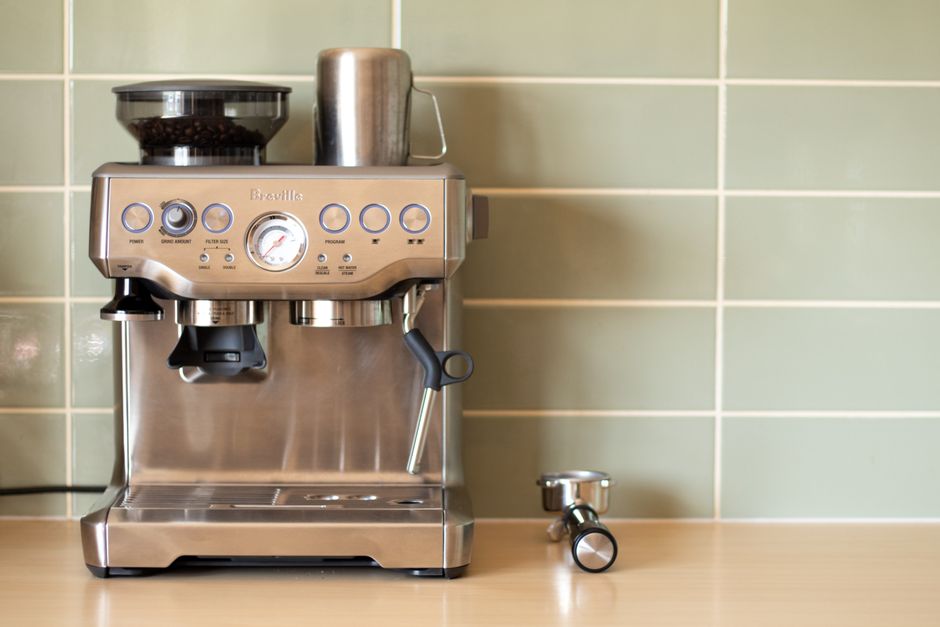
The foundational model uses a built-in conical burr grinder that feeds directly into the portafilter, paired with a 15-bar pressure pump and Breville's thermal stability system (±2°C temperature control). You manually tamp the grounds after grinding, giving you full control over extraction variables. Heat-up time is approximately 3 seconds, and the machine includes a steam wand for milk frothing.
Best for: Home baristas willing to invest time in technique, or experienced espresso drinkers who value manual control and refinement over convenience.
The Impress version keeps the same integrated conical burr grinder and thermal stability, but adds automatic dosing and tamping technology. The machine applies consistent pressure (approximately the correct amount based on your grind setting) automatically, removing one of the largest variables from inconsistent shots. You still manually steam milk and make operational decisions, but the grinder-to-tamp workflow is streamlined and repeatable.
Best for: Beginners who want espresso quality without mastering manual tamping, and busy households where consistency matters more than technique development.
Machines in this price bracket typically lack integrated grinders, require separate burr grinder purchases ($150–300), and struggle with temperature stability—many swing wildly in water temperature, causing shot-to-shot inconsistency. They demand manual dosing, tamping, and more troubleshooting. Pressure pumps are often less precise than Breville's 15-bar system.
Best for: Price-conscious experimenters who don't mind buying a separate grinder and accept more trial-and-error in dialing in shots.
These machines grind, dose, tamp, and brew automatically at the press of a button, with many offering one-touch milk frothing. They require minimal skill and deliver consistent results quickly, but you lose control over grind size, extraction time, and shot variables. Repair costs can be higher due to complexity, and coffee enthusiasts often criticize them for mediocre espresso quality despite convenience.
Best for: Time-pressed households prioritizing speed and consistency over espresso quality or the ability to dial in shots to preference.
If you're new to espresso or want consistent results without technique mastery: The Breville Barista Express Impress is the stronger choice. Automatic dosing and tamping eliminate two major variables, letting you focus on milk technique and dialing in grind size. The 4.3-star rating reflects this reliability for beginners. You're paying for automation that genuinely reduces user error—not flashy features.
If you're an experienced barista or enjoy the craft of dialing in shots: The original Barista Express offers the same thermal stability and grinder quality at a similar price, but with full manual control. You'll appreciate the ability to refine tamping pressure and extraction times to your exact preference, and you won't resent paying for automation you don't want.
If you need to stay under $500 or already own a quality grinder: Budget semi-automatic machines ($300–400) are justifiable if you're willing to buy a separate burr grinder and accept more shot inconsistency during the learning phase. However, once you add a standalone grinder ($200+), you're approaching Breville pricing anyway—making the integrated option often smarter financially.
If speed and zero learning curve are your priority: Super-automatic machines deliver faster results, but espresso quality suffers in this category, and reviews consistently show adoption drops after the novelty phase. The Breville machines cost similar amounts but actually deliver café-quality espresso worth the counter space.
The core trade-off: Both Breville models give you genuine espresso quality and thermal stability that cheaper machines simply cannot replicate. The choice between them is about control versus convenience—not about which one is objectively superior. Neither is "worth the price" if you're only planning to use it twice a month, but both become excellent investments for households that want daily café-quality espresso without a commercial machine footprint.
The Breville conical burr grinder is serviceable and good enough for the machine's pressure profile—it produces consistent particle size that directly impacts shot quality. However, it's not boutique-level equipment like dedicated espresso grinders costing $300+. For most users, it eliminates the grinder variable without requiring a separate $150–300 purchase, which is the real win.
The original Express requires manual tamping—applying consistent pressure by hand after the grinder dispenses grounds. This introduces shot-to-shot variability and has a steeper learning curve. The Impress removes this step through automatic tamping technology, making consistency achievable immediately. If you're new to espresso, the Impress saves weeks of trial-and-error frustration.
Both machines accept pre-ground coffee through a bypass function, but performance suffers. Pre-ground coffee loses flavor and aromatics quickly; the integrated grinder's value proposition is grinding fresh beans directly before brewing. If you're using pre-ground coffee regularly, you're negating one of the machine's key advantages and wasting the premium price you paid for the grinder.
Expect $20–40 monthly for espresso beans and occasional cleaning supplies (backflushing brushes, descaling solution). Repair costs are rare in the first few years if you backflush regularly and descale quarterly, but the steam wand and heating element can require service ($100–200) if neglected. Calculate the long-term value by comparing espresso machine costs against your current coffee shop spending—most households save money within 6–12 months.
Yes—both models have steam wands capable of producing microfoam for quality latte art and milk texture. However, steaming is a manual skill even on the Impress; you'll need to learn water temperature, steam pressure, and pitcher angle. The learning curve is shorter than espresso extraction, but it still requires practice to achieve café-quality results.
The Gaggia Classic Pro ($150–200) is significantly cheaper but requires a separate grinder purchase ($150–300), often totaling more than a Breville when factored together. The Gaggia also lacks Breville's thermal stability and fast heat-up time. For espresso quality, both can pull respectable shots if you invest in proper technique, but the Breville's integrated system eliminates variables and reduces user error—worth the premium if you value consistency.
Found this helpful? Share it!
Our team reviews cookware, appliances, and kitchen gadgets for home chefs so you don't have to. Every recommendation is based on real research: customer reviews, expert opinions, and value for money. Learn more about us →
This post contains affiliate links. We may earn a commission if you purchase through our links at no extra cost to you.
← Back to Best Kitchen Picks Daily| Retailer | Price Range | Shipping | Link |
|---|---|---|---|
| Amazon | Check Current Price | Free (Prime) | View on Amazon → |
| Walmart | Check Site | Free over $35 | Search → |
| Target | Check Site | Free over $35 | Search → |
Prices may vary. Click through to each retailer for current pricing.