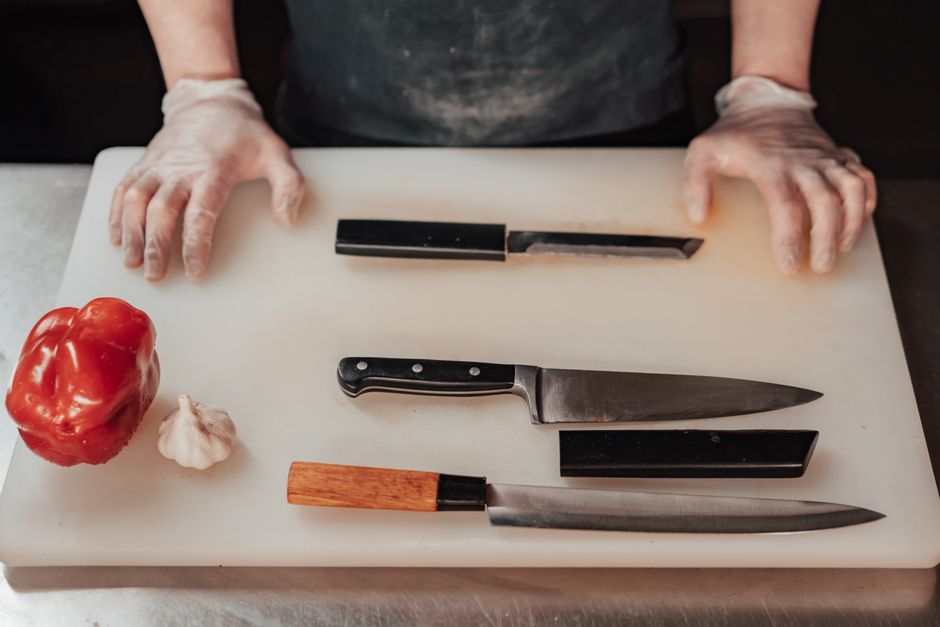
Photo: Mikhail Nilov / Pexels
Found this helpful? Share it!
When selecting a chef's knife, prioritize blade material and sharpness retention over brand name—German stainless steel holds an edge reasonably well for home use, while Japanese high-carbon steel stays sharper longer but requires more maintenance and careful hand-washing. Test the knife's balance point by resting it on your finger just ahead of the handle; a well-balanced blade should feel comfortable and reduce hand fatigue during extended prep work.
Our team reviews cookware, appliances, and kitchen gadgets for home chefs so you don't have to. Every recommendation is based on real research: customer reviews, expert opinions, and value for money. Learn more about us →
Professional chefs primarily use three essential knives: the chef's knife (8-10 inches), the paring knife (3-4 inches), and the serrated bread knife (8-10 inches). These versatile tools handle approximately 90% of kitchen tasks and form the foundation of any professional knife collection.
Professional chefs rely on a small selection of high-quality knives rather than extensive collections. The chef's knife is the workhorse, used for chopping, slicing, and mincing vegetables, proteins, and herbs. The paring knife handles detailed work like peeling and deveining, while the bread knife tackles crusty loaves and delicate pastries. Most professionals also keep a honing steel nearby to maintain blade sharpness throughout their shift.
The Chef's Knife: The Professional Standard
The chef's knife is the most important tool in any professional kitchen. Typically 8 to 10 inches long, this multipurpose blade excels at slicing, dicing, chopping, and mincing. Professional-grade chef's knives feature high-carbon stainless steel or carbon steel construction, providing superior edge retention and durability. German-style chef's knives tend to be heavier with a curved blade, while Japanese-style knives are lighter with straighter edges. Most professionals prefer knives weighing between 6 to 8 ounces for balance and control during extended use.
The Paring Knife: Precision Tool
Paring knives, typically 3 to 4 inches long, are essential for intricate work. Chefs use them for peeling vegetables, deveining shrimp, trimming fat from meat, and creating garnishes. The shorter blade and pointed tip provide exceptional control for detailed tasks that a chef's knife cannot efficiently accomplish. Professional paring knives maintain the same quality standards as chef's knives, with durable steel and excellent edge retention.
The Bread Knife: Serrated Specialist
The serrated bread knife features a long, toothed blade that cleanly cuts through crusty bread without crushing the interior crumb structure. At 8 to 10 inches long, it's equally valuable for slicing tomatoes, cakes, and other delicate items. Professional kitchens use bread knives daily, making quality construction essential for longevity and consistent performance.
Additional Professional Knives
While the three essentials dominate, some professionals maintain specialized knives for specific tasks. Boning knives (5-6 inches) feature a narrow, sharp blade for breaking down poultry and fish. Filleting knives provide flexibility for detailed fish work. Cleavers are common in Asian cuisines for chopping through bone. However, these supplementary knives are optional and depend on a chef's specific cooking style and cuisine specialization.
Professional chefs consistently emphasize that knife quality matters more than quantity. Executive chefs recommend investing in fewer, higher-quality knives rather than purchasing extensive sets. Thomas Keller, renowned chef and author, advocates for understanding your knives intimately—mastering proper technique with essential blades surpasses owning numerous mediocre tools. Professional kitchens prioritize regular maintenance, honing blades before service and sharpening them professionally every few months. Most experts agree that the chef's knife should be the first investment, followed by a paring knife and bread knife as the complete foundation.
A professional-quality chef knife set streamlines
As an Amazon Associate I earn from qualifying purchases.
← Back to All Reviews Shop on Amazon →| Retailer | Price Range | Shipping | Link |
|---|---|---|---|
| Amazon | Check Current Price | Free (Prime) | View on Amazon → |
| Walmart | Check Site | Free over $35 | Search → |
| Target | Check Site | Free over $35 | Search → |
Prices may vary. Click through to each retailer for current pricing.
The 8-inch chef's knife is the most essential knife you need, as it handles about 90% of kitchen tasks including chopping vegetables, slicing meat, and mincing herbs. Professional chefs rely on this one knife for everyday work, making it the best investment for a home cook starting out.
Chefs use a 10-inch boning knife or carving knife for breaking down raw meat and poultry, while a serrated knife works better for slicing cooked meat. For precise butchering work, professionals often prefer a boning knife with a 6-inch blade that allows for control and maneuverability.
Professional chefs primarily use straight-edge knives for most prep work because they provide cleaner cuts and are easier to sharpen, but they also keep serrated knives on hand specifically for bread and tomatoes where the jagged edge prevents crushing. Most pros use straight-edge knives about 80% of the time in the kitchen.
Top professional chefs commonly use German brands like Wüsthof and Zwilling J.A. Henckels, or Japanese brands like Shun and Tojiro, depending on their preference for weight and cutting style. You don't need an expensive brand as a home cook—a mid-range knife from any reputable brand will outperform a cheap one significantly.