By Best Kitchen Picks Daily • July 23, 2026 • Contains affiliate links
Affiliate Disclosure: As an Amazon Associate, we earn from qualifying purchases. Clicking our links costs you nothing extra and helps us keep reviewing products for free.
Switching to an induction cooktop means rethinking your cookware. Unlike traditional electric or gas stoves that heat a surface, induction cooktops generate a magnetic field that directly energizes your pots and pans—but only if they're made from the right materials.
Before purchasing induction cookware, test the bottom of any pot or pan with a magnet to ensure it has a ferromagnetic base, since induction cooktops only work with cookware made from magnetic materials like stainless steel or cast iron. Look for cookware labeled as induction-compatible or check the manufacturer's specifications, as non-magnetic materials like aluminum or copper alone won't heat on an induction surface without a special magnetic base layer.
The critical requirement: your cookware must be ferromagnetic. This immediately rules out pure aluminum, copper, and glass cookware, unless they have a special magnetic base layer bonded to the bottom. But here's the good news: most modern stainless steel cookware already works, and affordable induction-compatible options are now widely available.
This guide walks you through which materials actually work, how to test your existing cookware, and what to buy if you need to start fresh.
Stainless Steel Cookware (Magnetic)
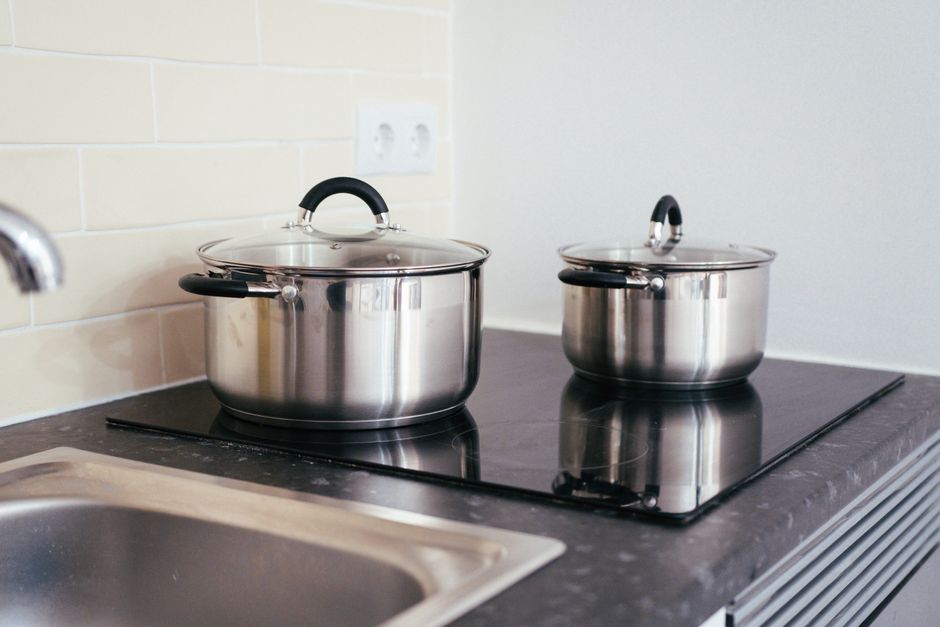
Most modern stainless steel cookware is induction-compatible as long as it contains iron content and has a ferromagnetic base. You can verify this with a simple magnet test—if a magnet sticks to the bottom, it will work. Magnetic stainless steel offers durability, even heating when the base layer is thick enough, and compatibility with all cooktop types (induction, gas, and electric).
The catch: not all stainless steel is magnetic. Some grades are non-magnetic, so the magnet test is essential before assuming your existing stainless cookware will work on induction.
Best for: Home cooks with existing stainless steel cookware or those wanting durable, versatile pans that work on any cooktop type.
Cast Iron Cookware
Cast iron is inherently ferromagnetic and works perfectly on induction cooktops. It heats evenly and retains heat exceptionally well. Cast iron cookware is affordable, long-lasting, and provides excellent cooking performance for searing, frying, and baking.
The drawbacks are weight, maintenance requirements (seasoning and hand-washing), and slower heat responsiveness compared to lighter cookware—though induction's precise heat control partially mitigates this.
Best for: Budget-conscious cooks who don't mind heavier cookware and are willing to maintain cast iron seasoning.
Carbon Steel Cookware
Carbon steel sits between stainless steel and cast iron: it's ferromagnetic, lighter than cast iron, heats quickly, and develops a natural non-stick seasoning over time. It works excellently on induction and offers good performance across all cooktop types.
Like cast iron, carbon steel requires seasoning and hand-washing, and it's not as convenient as non-stick or stainless steel for everyday cooking, though it's more forgiving than cast iron for beginners.
Best for: Experienced cooks who appreciate traditional cookware maintenance and want fast heat response with lower weight than cast iron.
Aluminum or Copper with Magnetic Base Layer
Pure aluminum and copper cookware won't work on induction because they're not ferromagnetic. However, some manufacturers now bond a ferromagnetic stainless steel or iron layer to the bottom of aluminum or copper cookware to make it induction-compatible. This allows you to keep the lightweight, excellent heat conductivity, and aesthetic appeal of copper or aluminum while gaining induction compatibility.
The downside: this hybrid construction is more expensive than standard aluminum or copper cookware, and the magnetic layer may eventually separate or wear if not durable enough.
Best for: Cooks who already own aluminum or copper cookware and want to adapt it to induction without replacing their entire collection.
Glass, Ceramic, or Non-Magnetic Cookware (Not Compatible)
Glass, ceramic, and pure non-ferromagnetic cookware simply won't heat on induction cooktops, no matter the brand or marketing claims. These materials don't interact with the magnetic field, so no heat is transferred. Before purchasing any new cookware for an induction cooktop, verify compatibility rather than relying on packaging descriptions.
Best for: Information only—not recommended for induction use unless you have no alternative.
Pros & Cons
Pros
✓ Induction cooktops are energy-efficient: heat is generated directly in the cookware, not wasted heating the cooktop surface, reducing energy consumption compared to electric or gas stoves.
✓ Precise temperature control: induction offers instant heat adjustment and more responsive cooking performance than traditional cooktops.
✓ Existing cookware may already work: if you have magnetic stainless steel or cast iron, testing with a magnet is free and takes seconds.
✓ Affordable induction-compatible cookware is now widely available across multiple price points and materials (stainless steel, cast iron, carbon steel).
✓ Safety advantage: induction cooktops don't get hot to the touch since heat is generated in the pan, not the cooktop surface, reducing burn risk.
Cons
✗ Non-magnetic cookware is incompatible: aluminum, copper, and glass won't work unless they have a magnetic base layer, forcing replacement of these items.
✗ Initial investment required: if your cookware isn't ferromagnetic, you'll need to purchase new pans—though this is offset by long-term energy savings and durability.
✗ Cookware base flatness matters: warped or domed bottoms reduce magnetic contact and heat transfer efficiency on induction surfaces.
Our Verdict
For most households switching to induction, magnetic stainless steel cookware is the best first choice. It's widely available at all price points, works on any cooktop type (making it future-proof if you move), and requires no special maintenance. Test your existing stainless steel with a magnet before buying new—you may already be compatible.
If you're starting from scratch and cost is your primary concern, cast iron is unbeatable: it's affordable, induction-compatible, and will last a lifetime. The trade-off is weight and the need for seasoning maintenance.
Carbon steel is the middle ground for those who want faster heat response than cast iron but don't want to rely solely on stainless steel.
If you have aluminum or copper cookware you love, hybrid cookware with magnetic base layers exists but costs more and should be tested before purchase. Avoid glass and non-magnetic ceramic cookware entirely—they simply won't work, regardless of brand or price. The critical first step: test all existing cookware with a magnet before investing in replacements.
Frequently Asked Questions
How do I test if my existing cookware works on induction?
Use a simple magnet (a refrigerator magnet works fine) and place it on the bottom of your pan. If the magnet sticks firmly, your cookware is ferromagnetic and will work on induction. If it falls off or barely adheres, it won't work. This test is free, instant, and 100% accurate.
Will my aluminum cookware work on induction if I put it on a special mat?
No. Induction adapters or mats don't reliably work because they interfere with the magnetic field. The magnetic field needs direct contact between the cooktop and ferromagnetic cookware for efficient heating. Always use cookware with a ferromagnetic base instead.
Does stainless steel cookware always work on induction?
Not always. Some stainless steel grades (like austenitic stainless steel) are non-magnetic. Always test with a magnet first. Most modern cookware labeled as cookware sets or sold at mainstream retailers is magnetic stainless steel, but vintage or specialty items may not be.
What does the induction symbol on cookware packaging mean?
The induction symbol (typically a coil icon) indicates the manufacturer has tested and verified the cookware is ferromagnetic and induction-compatible. It's a reliable shortcut if you're shopping for new cookware, but the magnet test is still the most foolproof verification method.
Can I use cast iron on induction cooktops?
Yes, absolutely. Cast iron is inherently ferromagnetic and works excellently on induction. It heats evenly and retains heat well. The main drawbacks are weight and the need for hand-washing and seasoning maintenance, not incompatibility.
Is induction-compatible cookware more expensive than regular cookware?
Not necessarily. Ferromagnetic stainless steel, cast iron, and carbon steel are competitively priced or even cheaper than high-end non-magnetic cookware. You're paying for material quality, not induction compatibility. Budget induction cookware starts at the same price point as budget traditional cookware.
Our team reviews cookware, appliances, and kitchen gadgets for home chefs so you don't have to. Every recommendation is based on real research: customer reviews, expert opinions, and value for money. Learn more about us →
This post contains affiliate links. We may earn a commission if you purchase through our links at no extra cost to you.