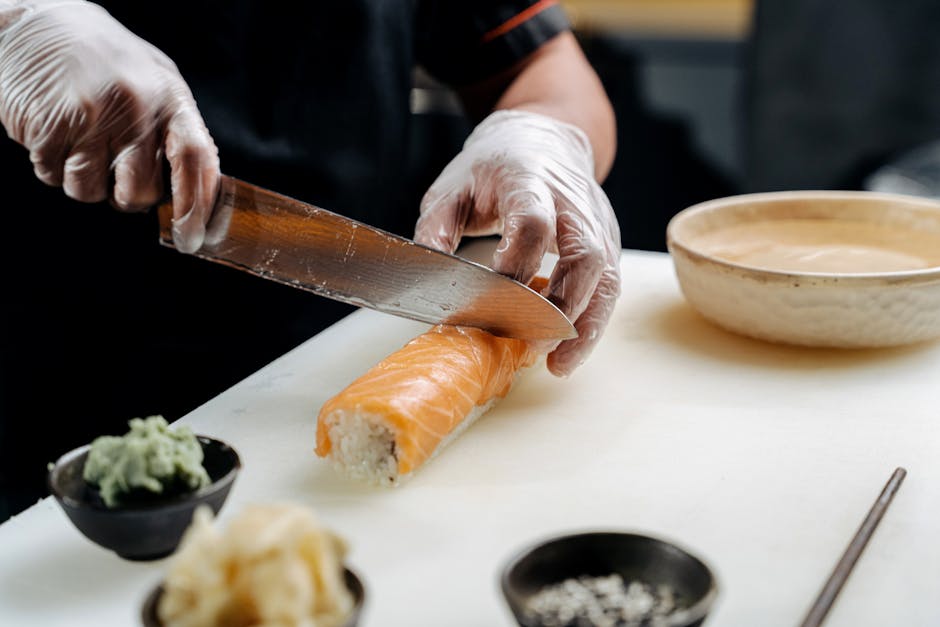
Photo: Ivan S / Pexels
Found this helpful? Share it!
Our team reviews cookware, appliances, and kitchen gadgets for home chefs so you don't have to. Every recommendation is based on real research: customer reviews, expert opinions, and value for money. Learn more about us →
Investing in the right Japanese chef knife can transform your cooking experience, whether you're a home cook or someone who spends significant time in the kitchen. Different cutting tasks require different blade shapes, lengths, and weights, and choosing poorly means you'll either struggle with certain foods or risk damaging your knife. Understanding which knife works best for each task ensures you get cleaner cuts, maintain your knives longer, and actually enjoy meal preparation.
The MAC Superior Gyuto 8-inch chef knife represents an excellent entry point into Japanese knife ownership for most home cooks. This 8-inch blade handles roughly 80% of kitchen tasks—dicing onions, slicing chicken breast, mincing garlic, and breaking down vegetables with equal competence. The blade uses MAC's proprietary stainless steel (keeping maintenance simple), features excellent edge retention, and the ergonomic handle is forgiving for both pinch and hammer grips while you're learning proper technique.
"The key to selecting the right Japanese chef knife lies in understanding blade geometry and steel composition—a gyuto's 50-degree edge angle excels for precise vegetable brunoise, while a nakiri's flat blade distributes force evenly for delicate herb chiffonade, and a deba's thicker spine handles fish fabrication without deflection. Matching the knife's curvature and weight distribution to your specific cutting motion prevents fatigue and maximizes control across different proteins and produce."
The Gyuto's curved edge and moderate blade height make it incredibly versatile without specializing so narrowly that it becomes a one-trick tool. Unlike a Nakiri (which excels only on vegetables) or a Yanagiba (which is worthless for anything but raw fish), a quality Gyuto adapts to whatever you're preparing. The 8-inch length is genuinely the sweet spot—long enough for efficiently processing larger items, short enough to maintain control and precision on delicate work. Most home cooks find they reach for an 8-inch blade 90% of the time, making it the single best investment for a knife-buying beginner.
Japanese knife steel's hardness means your edge stays sharp significantly longer than Western knives, reducing the frequency you need to sharpen or hone. This matters because less experienced cooks often damage their blades by sharpening incorrectly—the longer you can maintain an edge, the fewer opportunities you have to mess it up. The lighter weight compared to German-style chef's knives reduces hand fatigue during extended prep work, and the precise, thin edge creates cleaner cuts that keep food fresher and looking better on the plate.
A gyuto is a versatile 8-10 inch chef's knife that excels at slicing, dicing, and mincing with a curved blade that rocks on the cutting board. A santoku is shorter (5-7 inches) with a flatter blade and is better for precise chopping of vegetables, fish, and meat in a up-and-down motion rather than rocking.
An 8-inch blade is ideal for most home cooks and handles 90% of cutting tasks from vegetables to proteins. If you have limited counter space or smaller hands, a 6-7 inch blade works well; if you frequently break down large roasts or cabbages, consider a 9-10 inch blade.
Yes—Japanese knives have harder steel and thinner blades, so they require hand washing, immediate drying, and regular honing with a whetstone every 2-4 weeks to maintain their edge. They're more fragile than German knives and shouldn't go in the dishwasher or be used on hard surfaces like bones.
Look for mid-range gyuto knives ($80-150) from brands like MAC, Victorinox Fibrox, or Mercer, which offer excellent edge retention and durability for learning proper technique. Avoid the cheapest options under $30 as they won't hold an edge, but you don't need to spend $300+ as a beginner.
As an Amazon Associate I earn from qualifying purchases.
← Back to All Reviews| Retailer | Price Range | Shipping | Link |
|---|---|---|---|
| Amazon | Check Current Price | Free (Prime) | View on Amazon → |
| Walmart | Check Site | Free over $35 | Search → |
| Target | Check Site | Free over $35 | Search → |
Prices may vary. Click through to each retailer for current pricing.
Video results for: How To Choose The Right Japanese Chef Knife For Different Cutting Tasks (2026)