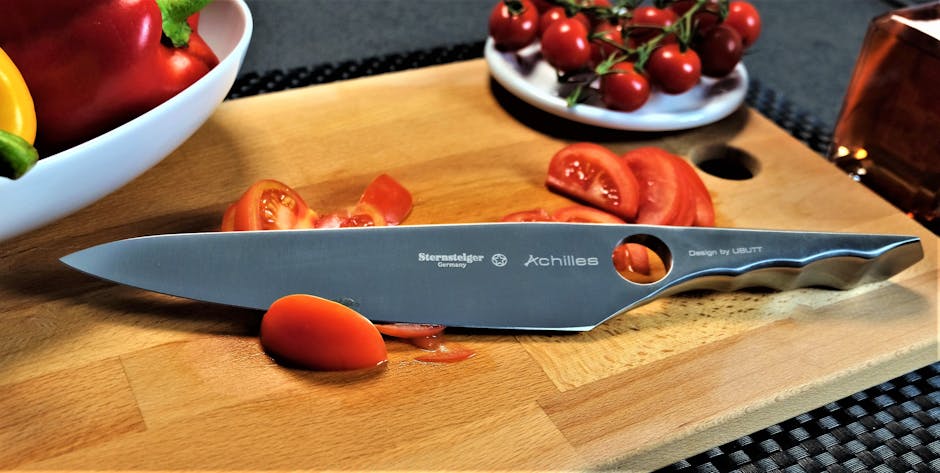
Photo: Sternsteiger Stahlwaren / Pexels
Found this helpful? Share it!
Our team reviews cookware, appliances, and kitchen gadgets for home chefs so you don't have to. Every recommendation is based on real research: customer reviews, expert opinions, and value for money. Learn more about us →
If you cook dinner most nights of the week, your chef's knife is the single tool you'll touch more than any other — more than your skillet, more than your cutting board, more than that air fryer you swore you'd use daily. German chef knives have earned their reputation in home kitchens because they're forgiving: softer steel that survives the occasional bone strike, a curved belly that rocks through parsley, and enough heft to power through a butternut squash without you white-knuckling the handle. The trouble is that "German chef knife" covers everything from a $40 workhorse to a $300 forged showpiece, and the differences that matter to a home cook aren't the ones the marketing copy talks about.
Wüsthof Classic Ikon 8-Inch Chef's Knife
Look for a blade length between 6-8 inches and a weight that feels balanced in your hand during a brief test, as German knives tend to be heavier than other styles and the right balance reduces hand fatigue during extended chopping and prep work. Verify the blade is made from high-carbon stainless steel rather than pure stainless, since this composition offers better edge retention and easier maintenance for home cooks who may not sharpen frequently.
For a home cook — not a line cook, not a collector — the Classic Ikon is the one we keep recommending, and it's the one that lives on our own magnetic strip. Here's specifically why it fits this use case:
Budget alternative: the Mercer Culinary Genesis 8-Inch uses the same X50CrMoV15 steel with a forged construction and a grippy Santoprene handle for a fraction of the price. It won't hold an edge quite as long as the Wüsthof, but for a home cook who sharpens regularly, it's a remarkably honest knife.
Home cooking is unpredictable in a way professional cooking isn't. You're not doing 200 covers of identical brunoise — you're spatchcocking a chicken on Sunday, mincing garlic on Tuesday, hacking through an acorn squash on Thursday, and occasionally letting the blade tap the plate because you're watching something on your phone. German steel is specifically suited to that chaos. At 56 HRC it's soft enough to bend rather than break, which means a rolled edge you can fix in seconds with a honing steel rather than a chip you have to send out for repair. A Japanese blade at 62 HRC will out-slice it on a tomato, but it punishes carelessness in a way that makes most home cooks nervous — and a knife you're nervous about is a knife you don't reach for.
The half-bolster design matters even more over the long haul. Most home cooks eventually get a whetstone, a Chef'sChoice electric sharpener, or a $10 pull-through, and every sharpening removes a tiny bit of steel from the blade — but not from the bolster, because the bolster is thicker and sits proud of the edge. On a full-bolster knife, that mismatch compounds until the heel of your blade physically can't contact the board, and you lose the ability to chop through a scallion cleanly. The Classic Ikon sidesteps that entirely. Combined with the fact that Wüsthof's warranty and sharpening service are genuinely good, it's a knife with a 30-year horizon rather than a 5-year one, which is exactly the math that makes a $160 knife cheaper than three $50 knives.
Buy the 8-inch Wüsthof Classic Ikon, pair it with a $25 honing steel, and give it ten seconds of attention before each cooking session — that combination will out-perform a $400 knife you're afraid to use. Check our full chef's knife comparison guide for side-by-side testing notes, or head to our knife sharpening basics walkthrough to learn the two-minute routine that keeps a German blade cutting like new.
An 8-inch German chef knife is ideal for most home cooks as it balances versatility and control for everyday tasks like chopping vegetables, slicing meat, and mincing herbs. If you have smaller hands or limited counter space, a 7-inch blade works well, while 10-inch blades are better suited for professional kitchens or those who frequently process large quantities of food.
German chef knives are generally better for home cooks because they're more durable, require less frequent sharpening, and are more forgiving if you occasionally use them on harder surfaces. They have a heavier blade and wider spine that make them excellent for beginners, while Japanese knives require more careful technique and maintenance.
A quality German chef knife for home cooking typically costs between $50-$150, with reliable brands like Wüsthof, Zwilling J.A. Henckels, and Victorinox offering excellent options in this range. Avoid extremely cheap knives under $30 as they won't hold an edge, but you don't need to spend $300+ for reliable home use.
German chef knives are low-maintenance compared to Japanese knives—hand wash them immediately after use and dry with a towel, then sharpen with a steel every few uses or a whetstone every 6-12 months depending on usage. Avoid the dishwasher as extreme heat and movement can damage the blade and handle.
As an Amazon Associate I earn from qualifying purchases.
← Back to All Reviews| Retailer | Price Range | Shipping | Link |
|---|---|---|---|
| Amazon | Check Current Price | Free (Prime) | View on Amazon → |
| Walmart | Check Site | Free over $35 | Search → |
| Target | Check Site | Free over $35 | Search → |
Prices may vary. Click through to each retailer for current pricing.